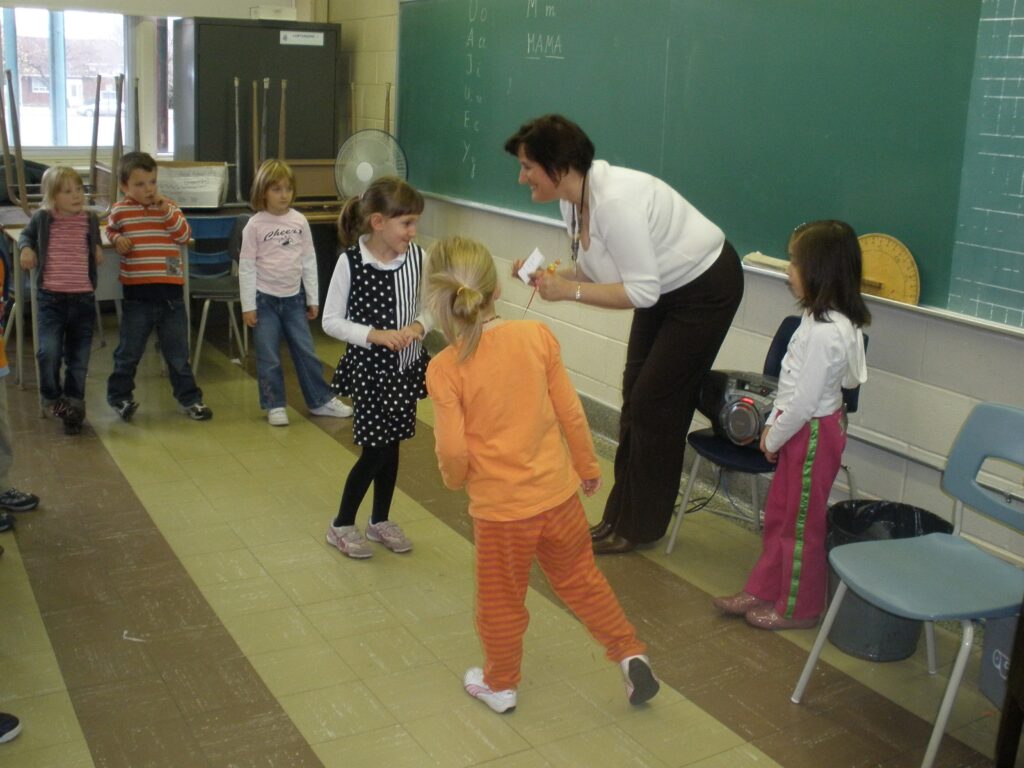

When somebody asks me what I do, I reply that I am a math and science teacher. I have been a teacher for the last nine years, and a tutor even before then. I taught all sorts of subjects and levels, in many different schools and even in two separate provinces (Alberta and Quebec). I feel like I have a lot of experience, and being exposed to the different types of schools (public, charter, private) I can compare the teaching going on in many different environments and I have opinions of what seems to work better for me. I pick and choose what I like and what works best. I learn and apply from one environment to the next. The overall result is that I am becoming a great teacher. In fact, I might be called an expert teacher by my students, peers and superiors.
When teaching, the teacher always should have an objective in mind: what is the purpose of this lesson, this activity, this game? So when I am teaching how to factor polynomials, I could use many games (factoring bingo), activities (group work / collaboration), and manipulatives (algebra tiles), but I also have to have a purpose in mind. For instance I can’t tell my students to play Monopoly, as that is irrelevant to factoring polynomials, even though the Monopoly game could be used in a different situation to teach how to count money, give out change, etc. Similarly in a science classroom, we shouldn’t be showing explosions unless there is a relevance in what we want the students to learn.
I was impressed from the very moment I read about Knowledge Building in the Cambridge Handbook of the Learning Sciences (Sawyer, 2006, pp. 97 – 115). As a science teacher, I see the enormous potential of this learning philosophy, and cannot wait to apply it to my existing teaching repertoire. In order to implement the principles of Knowledge Building, I must understand it fully and understand how to apply it. To this end, I am writing this thought paper with two articles on Knowledge Building as a backdrop. The first is “Learning to Work Creatively With Knowledge” by Carl Bereiter and Marlene Scardamalia (2003) and the second is “Student-Directed Assessment of Knowledge Building Using Electronic Portfolios” by Jan van Aalst and Carol K. K. Chan (2007). The first article serves as the theory portion of my understanding of Knowledge Building. The second article provides an example of Knowledge Building in practice and presents a possible way of implementing the innovative learning environment as well as assessing students in the collaborative Knowledge Building setting.
I see teaching science as having two different sides. The first side is teaching the basics, the processes, the structures of a lab report, the ways of solving a physics problem, the organization. Let’s call this the “alphabet” of the scientist. Without this, the students could not achieve any kind of success in the sciences. It is a way of communication in the scientific world, the building blocks of science. In the same way that a child cannot read a beautiful story without knowing the alphabet first, the scientist cannot see or understand the complex design of car without first understanding the mechanisms of the simple machines or the fuel combustion effects, or even the knowledge of the basic elements or simple kinematics. I would say that traditional teaching focuses on these basic skills. Teaching only these kinds of skills is equivalent to presenting knowledge in what Bereiter and Scardamalia (2003) call belief mode.
To provide the best experiences, we use technologies like cookies to store and/or access device information. Consenting to these technologies will allow us to process data such as browsing behavior or unique IDs on this site. Not consenting or withdrawing consent, may adversely affect certain features and functions.
Functional
Always active
The technical storage or access is strictly necessary for the legitimate purpose of enabling the use of a specific service explicitly requested by the subscriber or user, or for the sole purpose of carrying out the transmission of a communication over an electronic communications network.
Preferences
The technical storage or access is necessary for the legitimate purpose of storing preferences that are not requested by the subscriber or user.
Statistics
The technical storage or access that is used exclusively for statistical purposes.The technical storage or access that is used exclusively for anonymous statistical purposes. Without a subpoena, voluntary compliance on the part of your Internet Service Provider, or additional records from a third party, information stored or retrieved for this purpose alone cannot usually be used to identify you.
Marketing
The technical storage or access is required to create user profiles to send advertising, or to track the user on a website or across several websites for similar marketing purposes.